What Spatial Audio Gets Wrong & How We're Fixing It

Spatial audio has a problem. Not with the idea, the idea is brilliant. Not with the content, more of it exists right now than ever before. The problem is with what happens between the studio and your ears.
For most people, spatial audio isn't working. Not properly. And the frustrating part is that most people don't even know it. They think they're hearing the full experience when in fact, they're not.
Here's what's actually going wrong and what we're doing about it as part of our mission to democratise spatial audio.
The Promise vs The Reality
Spatial audio, when it works as intended, is genuinely transformative. Sound doesn't just come from a speaker. It exists in space around you, above, below, behind, beside. Your brain stops processing it as audio and starts experiencing it as an environment. It's the difference between watching something and feeling like you're inside it.
The technology to create that experience has existed for years. Studios are mixing in Dolby Atmos. Artists are crafting immersive soundscapes with extraordinary care. Games, films and music are being produced specifically to be heard in three dimensions.
And then most of it reaches listeners through a pair of stereo speakers or a soundbar, and the effect collapses.
This isn't a content problem. It's a playback problem.
Why Your Ears Are Extraordinary (And Why That Matters)
To understand why playback is so hard to get right, it helps to appreciate just how sophisticated human hearing actually is.
Your auditory system is capable of pinpointing the position of a sound source in three dimensions, in front, behind, above, below, almost instantaneously, and largely without conscious effort. It does this using two primary mechanisms.
The first is the Interaural Time Difference (ITD). Sound coming from your right reaches your right ear a fraction of a millisecond before it reaches your left. Your brain reads that gap and uses it to calculate direction.
The second is the Interaural Level Difference (ILD). The ear closest to a sound source hears it slightly louder. Again, your brain processes that difference as a spatial cue.
On top of these, the shape of your outer ears, the pinnae, subtly modifies incoming sound in ways that are unique to each direction. These spectral signatures, known as Head-Related Transfer Functions (HRTFs), give your brain the information it needs to place sounds above or behind you, not just left or right.
Together, these cues create a remarkably accurate, constantly-updating map of the acoustic world around you. Spatial audio works by recreating those cues digitally, feeding your ears the right signals to convince your brain that sounds exist in physical space.
The challenge is delivering those signals cleanly. And that's where most systems fall short.
The Headphone Advantage And Its Limitations
Headphones solve the spatial audio delivery problem neatly, if imperfectly.
With headphones, the left channel goes exclusively to your left ear and the right exclusively to your right. There's no bleed, no interference. The binaural signal, the carefully crafted set of spatial cues, arrives intact. It's a controlled environment, and spatial audio thrives in controlled environments.
That's why binaural audio for headphones has become relatively widespread. The delivery mechanism cooperates with the content.
But headphones are isolating. They're not how most people naturally want to experience music, or films, or games. And for many listening environments, a living room, a home office, a shared space, they're simply not practical.
Speakers remain the way most people listen. And speakers, unfortunately, have a fundamental problem.
The Crosstalk Problem
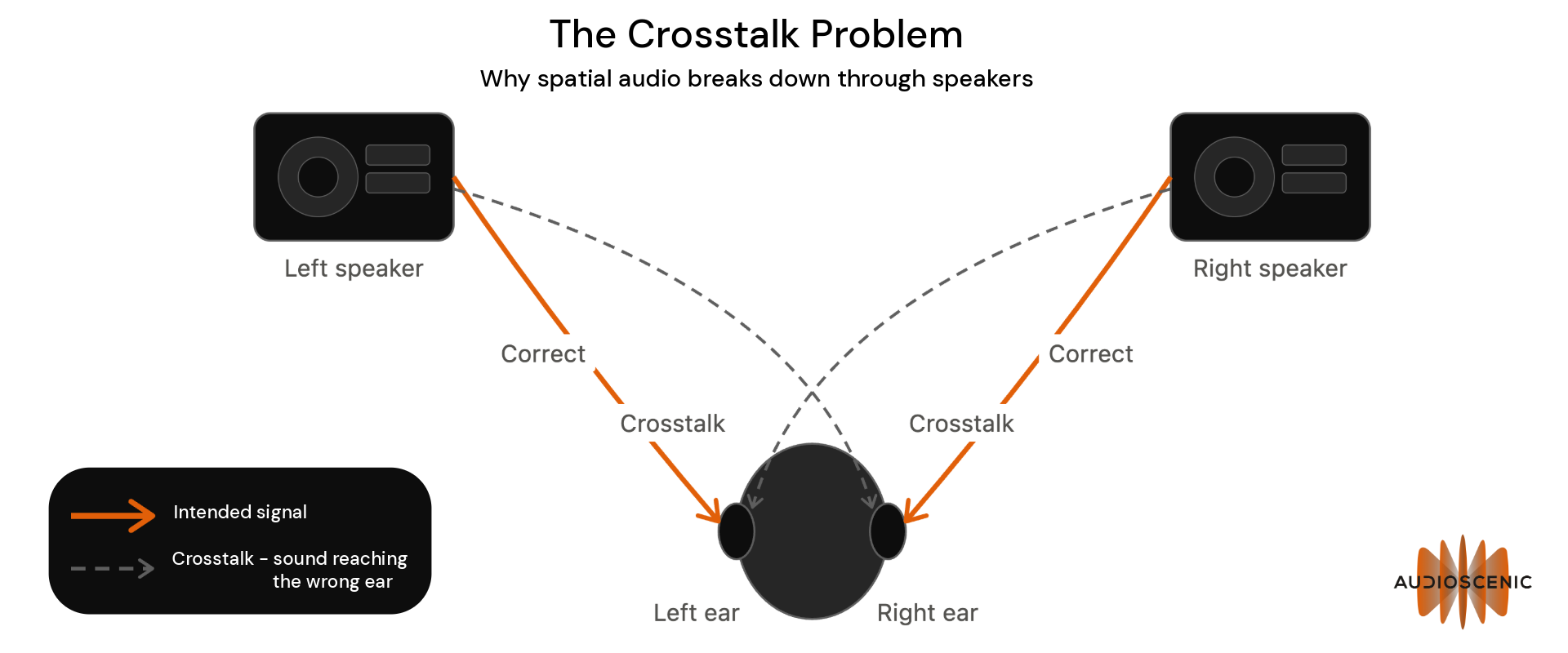
Sit in front of a pair of stereo speakers and play a sound through the left speaker only. Most of it will reach your left ear, but some will travel across and reach your right ear too. The same happens in reverse for the right speaker.
This bleed is called crosstalk, and it's the enemy of spatial audio from speakers.
The moment audio intended for one ear reaches the other, the binaural cues break down. The carefully calculated timing differences, the level differences, the spectral fingerprints, all of it gets muddied. The sound collapses from three-dimensional to flat. What the creator intended becomes something significantly less than what the listener receives.
It's why an audio engineer can sit in a professional studio and experience an immersive mix that genuinely transports them and then that same mix reaches a listener at home through a soundbar and feels like, well, a soundbar.
The value chain breaks. Creators invest in immersive formats. Distributors pass the content through and listeners receive a diminished version without knowing what they're missing. Over time, that erodes the incentive to create spatially in the first place.
Crosstalk Cancellation: A Brilliant Idea With a Catch
The solution to crosstalk has been known about since the 1960s. It's called crosstalk cancellation (CTC), and the principle is elegant.
If you know exactly where a listener is sitting, you can calculate the crosstalk that's going to reach the wrong ear and introduce a precisely engineered opposing signal that neutralises it before it arrives. The result is clean channel separation, the left ear gets the left signal, the right ear gets the right signal, without interference. Virtual headphones, achieved through speakers.
The problem is that sweet spot.
Traditional crosstalk cancellation systems only work if the listener stays in exactly the right position. Move your head even five centimetres from the designated point, and the effect deteriorates rapidly, the carefully calculated cancellation signals no longer line up, the crosstalk creeps back in, and the spatial experience collapses.
For a laboratory demonstration, that's manageable. For a real person watching a film at home, shifting on the sofa, turning to talk to someone, leaning forward to pick up their drink, it's a dealbreaker.
This is the problem that has kept spatial audio from speakers as a niche technology for decades. The engineering is sound. The listening conditions rarely are.
How Beamcasting Changes Everything
This is where Audioscenic's approach is fundamentally different.
Our technology combines two things: Beamcasting, precise directional control of sound and adaptive crosstalk cancellation that moves with the listener in real time.
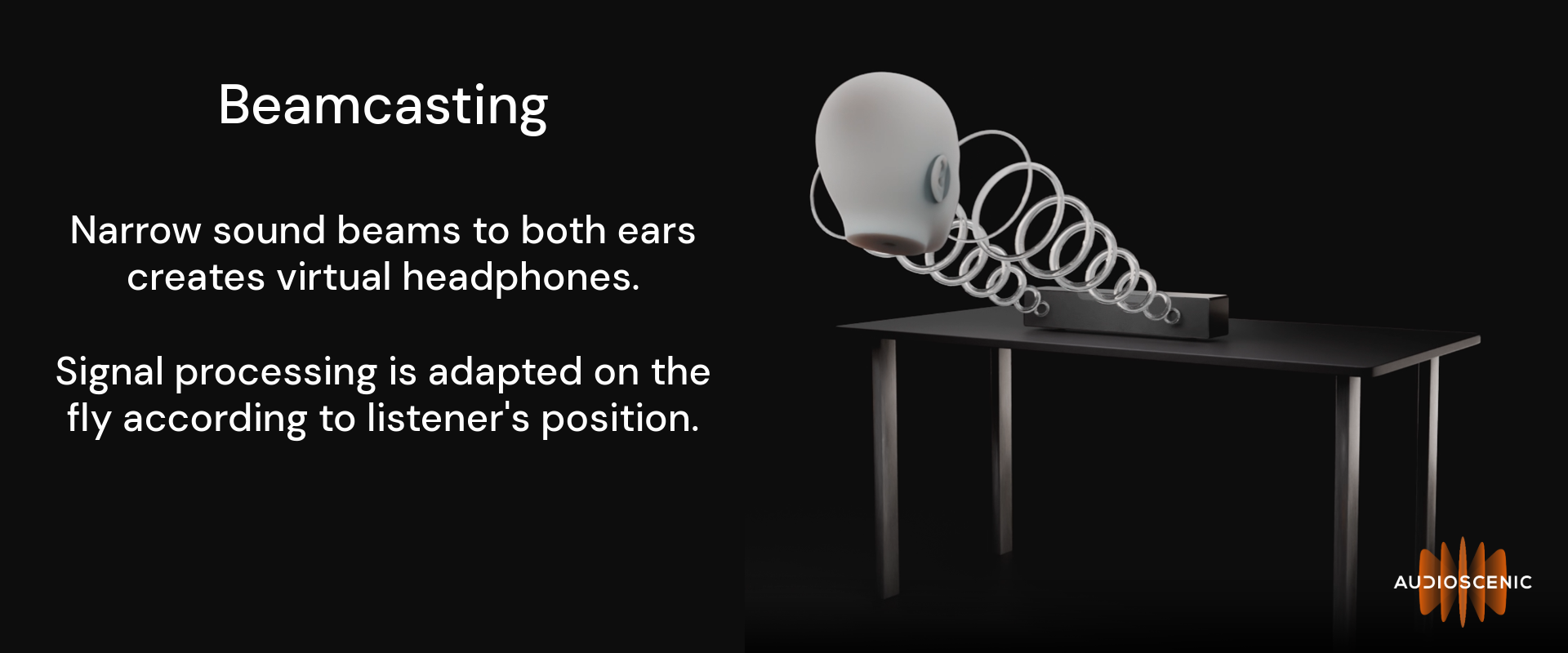
Beamcasting uses an array of speakers working in careful coordination. By controlling the timing and phase of each speaker's output, constructive and destructive interference patterns are created, areas where sound builds and areas where it cancels. This allows sound to be shaped into precise beams, directed at specific points in space. In our case, one beam to your left ear and one to your right, carrying the correct binaural signal for each.
This is already a significant improvement on standard crosstalk cancellation. Because the sound is being steered rather than simply broadcast, less unwanted signal reaches the wrong ear in the first place. The crosstalk cancellation algorithm has less work to do, and the result is more precise.
But the real breakthrough is what happens when the listener moves.
A Sweet Spot That Follows You
At the core of our technology is a machine learning-powered head tracking system. Using a built-in sensor, it continuously monitors the position of the listener's ears relative to the device in real time. As you move, leaning back, turning your head, shifting position, the system updates instantly. The beams repoint. The crosstalk cancellation recalculates. The sweet spot follows you.
Critically, the system only captures position data landmarks. It does not store video, images, or any personal information about the user. It simply knows where your ears are, right now, and adjusts the audio accordingly.
The effect of this adaptivity is measurable and significant. Where a conventional crosstalk cancellation system provides effective spatial audio within roughly four degrees of the central listening position, our technology maintains consistent performance across a range of fifteen degrees or more, with no theoretical limit to how far that range can extend.
In practical terms: you can move naturally, and the experience stays intact.
Better Than Headphones. Better Than Surround Sound.
That's a significant claim, so it's worth backing it up.
Audioscenic conducted a controlled psychoacoustic experiment comparing an Amphi-enabled soundbar against three alternatives: a 5.1 surround sound system, headphones, and a commercial gaming soundbar. Fifteen listeners evaluated the systems across four spatial attributes, horizontal width, immersion, depth of field and realism, using a range of immersive content including games and film.

Across every attribute, the powered by AUDIOSCENIC soundbar was preferred. Not marginally but consistently, and across all content types.
That result reflects something important: accurate spatial audio reproduction isn't just about speaker count or format support. It's about delivering the right signal to the right ear, cleanly, without distortion, wherever the listener happens to be. When you achieve that, the experience becomes more convincing than headphones, because it feels natural, not worn.
Where This Is Going
Spatial audio content is already here. The formats, Dolby Atmos, DTS:X, and emerging open-source options like Eclipsa, backed by Google and Samsung are established and growing. The creative community is producing immersive work. The pipeline is filling.
What's been missing is the playback layer. The technology that takes all of that creative intent and delivers it to listeners as it was meant to be heard.
Audioscenic's technology is designed to be that layer, not as a specialist product for audiophiles, but as licensable technology that can be built into the laptops, monitors and soundbars that people already own and use every day. It's already inside products on the market and more are coming.
Fix playback, and you fix the value chain. Creators get a reason to mix spatially. Listeners get an experience worth seeking out. The whole ecosystem moves forward.
Spatial audio doesn't have a content problem. It has a delivery problem. And that's exactly the kind of problem worth solving.
Want to follow what's coming next? Sign up to the Audioscenic newsletter for updates.


